


Water Quality
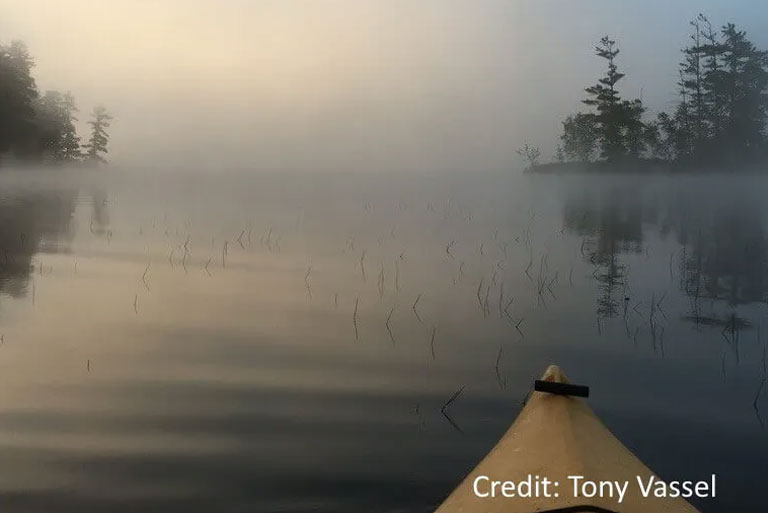
As a recreational water body and an active fishery the quality of Balch Lake’s water is important to all. Beyond managing the lake’s invasive species mitigation efforts, BLIMP is also focused on ways to track and manage the quality (including clarity) of the water.
In the Spring and Summer of 2021 BLIMP started conducting regular water quality measurements. Volunteers are needed to help with this initiative around the lake (the expectation is that this will be about 3-4 hours of initial training and then 2-4 hours/month during the testing period) Questions about Balch Lake water quality and testing can be directed here.
Please Respect our Water Samplers!
As we ask you to do for our invasive milfoil divers, please respect any pontoon boat you see flying the “BLIMP Water Testing” flag by staying as far away as possible and minimizing your wake as you pass. We test 5 different places on Balch about 5-7 times a season, and it’s critical that we do the testing in the calmest possible water to get accurate and consistent results. We’re out during the 10-2-time frame and avoid inclement weather, holidays and weekends. If you’re interested in being a water sampler, please contact Tony Taglieferro (tonytag63@gmail.com). No scientific background or experience is necessary—just a willingness to pay careful attention to the sampling procedures that we’ll show you how to do on your first time out! Samplers are typically assigned to go out 2-3 times per season with at least two other people. It takes about an hour-and-a-half and is a relaxed, sociable trip. Couples are most welcome!
BLIMP Water Quality Monitoring Program
Monitoring water quality in addition to invasive weed control is critical to the future of our lake. The complexities of where to sample, how frequently to sample, what parameters to measure, etc, are important considerations in monitoring water quality. In collaboration with the University of New Hampshire, BLIMP is actively monitoring each of these important considerations:
Sampling Sites and Frequency. We are sampling 6 different sites on Balch: two “deep lake” sites with depths of 46 feet—the deepest part of Balch—and a 42 feet site not too far from Custom House Island; the mouth of the river inlet (near the net) to get a sense of the water quality coming into the lake; the middle of Stump Pond, since a significant amount of the ProcellaCOR chemical application occurs there; near the entrance to Wyman Cove as a nearby site to chemical application, and Stoddard Narrows, where Balch starts to narrow to form the outlet to the dam and thus represents the outflow partner to the river inlet sample.
If you’re wondering why we use a combination of deep-water and much shallower sampling sites, here’s the rationale: Shallower sampling sites like the river inlet, Stump Pond, Wyman, and near the dam are “leading indicators” of problems. Changes in these areas might be very short-term but they give us a heads-up that lake-wide trouble may be ahead. The two deep-water sites are “lagging indicators”, meaning that if they start to go south we need to take immediate action. Very importantly, the deep-lake data is how the state and other organizations (for example, the Acton-Wakefield Watershed Alliance) classify Balch and directly affects how Balch Lake is presented to folks interested in renting or buying. For these reasons, the primary deep-lake site is considered the most critical and is the one most carefully probed.
Parameters to Measure. Depending on the sampling site, we will be monitoring several different critical parameters. Among the options we have considered include water clarity, chlorophyll, phosphorous, water color, pH, alkalinity, dissolved oxygen, and cyanobacteria. Here are the parameters we will be measuring and the rationale for doing so:
Water clarity: This is a critical parameter for Balch and most other lakes and ponds because it combines key factors such as water color, algal (typically cyanobacteria) blooms, and siltation. The further down light can penetrate correlates positively with overall lake health, and it also correlates with how deep we might expect to see invasive plants. Since invasive plants require light to grow, this measurement in combination with the experiences of our divers gives us an idea of where potential growth areas might be for us to keep an eye on. Water clarity is measured at the primary deep-lake site of 46 feet.
Phosphorous/Phosphate: This is the most important leading indicator for potential water quality issues on Balch Lake. Phosphates are the major contributor to overall plant and algal growth In Maine and New Hampshire. Fortunately, lakes like Balch do not need to be overly concerned with acid rain, pH, or buffering capacity (also known as alkalinity—more on this later). Phosphates are the limiting factor for algae and water plant reproduction and comes primarily from lawn fertilizers and detergents that can leach into the lake as well as human waste/septic system failure. Because they are such an important parameter to measure, all 6 sampling sites are monitored for phosphates.
How do I minimize phosphates and other nutrients entering the lake from my property?
Here are the Top 8 things you can do in order of their importance to reduce phosphate and other nutrients from entering the lake—except for septic system pumping, nearly all of them are easy to do and cost nothing or at most a few dollars. Whatever you can do is helpful even if you can’t do them all.
1. Maintain and inspect septic systems regularly by pumping every 2-3 years.
2. Stop rainwater runoff and erosion from reaching the lake.
3. Maintain or restore natural shoreline vegetation buffers such as trees, shrubs, grass, and natural vegetation.
4. Avoid phosphorus fertilizer—phosphorous is always in high supply, so you’re looking for a fertilizer with 0 as the middle number, eg, 10-0-10.
5. Do not use garbage disposals—all food waste should be put in the garbage or compost pile.
6. Fix leaking toilets, faucets, and other excess water inputs.
7. Keep leaves, grass clippings, pet waste, and ash out of the lake.
8. Use phosphate-free laundry and dishwasher detergents, soaps, and cleaners. They’re effective and easy to find (Tide Free and Gentle, All Free Clear, Arm and Hammer Free and Clear, Cascade Free and Clear, etc)
Water Color: Water color per se is not a direct indicator of lake health—most lakes including Balch have noticeable color due to dissolved acids (typically tannins, the same acids found in red wine and coffee beans) and nutrients that are part of the lake via rain run-off, endogenous plant degradation, and lake bottom solid constituents that dissolve into the lake. By the way, nearly all “colorless” lakes are actually dead from a biological standpoint due to acid rain conditions combined with a lack of buffering capacity (alkalinity—discussed later). Nonetheless, it’s important to monitor color as it provides useful information when combined with water clarity observations. It is normal for water color to change as the growing season progresses from May to October but it should be reasonably consistent from year to year. More importantly, if water color increases it is a sign that something has changed that we need to figure out. Water color is measured at the primary deep lake site.
Chlorophyll: Since all algae and other plants make chlorophyll, measuring the amount of chlorophyll in a sample gives an excellent indicator of the algal load on Balch along with a general measurement of plant degradation. This will be done at the primary deep-lake site.
Cyanobacteria: Commonly known as blue-green algae, cyanobacteria are the most common cause of algal blooms in Maine and New Hampshire lakes. These blooms result in large fish kills and a loss of swimming and other recreational opportunities when they occur. Cyanobacteria produce a specific chemical than can be readily measured. We will be taking water samples for cyanobacteria at the deep-lake site and any other sites where an algal bloom is sighted or reported.
Almost all lakes like Balch have cyanobacteria lurking 15-30 feet below the surface or hiding in the bottom sediment. Our cyanobacteria are normally about 25 below the surface and are almost certainly hiding in the sediment of shallower areas. BLIMP works with UNH, NH-DES, and ME-DEP to monitor this annually. Almost every lake in our area has had a cyanobacteria bloom, except Balch. In part, that’s because our water flush rate* and prevailing winds work against cyanobacteria blooms. But . . . we need to be vigilant because any lake, no matter how clean, can experience a bloom. This is especially true in our coves and bays that do not have a lot of water flow. The weather conditions that favor a bloom are several hot, calm summer days. The other major factor promoting a cyanobacteria bloom are boat and PWC wakes too close to shore, especially in shallower areas.
How do you recognize a cyanobacteria bloom? If you see water that looks like spilled green paint, pea soup, blue-green streaks, floating scum, or unusual green material collecting along shore or in a shallow area, avoid contact, keep pets out, take photos from shore if possible, and report the location/date/time to John Castellot (john.castellot@tufts.edu; 617-835-2660). Repeat: Do NOT go into the water near a suspected bloom. The toxins produced by cyanobacteria are highly injurious and can quickly cause serious health issues even with minimal contact. The green algae blooms we see pretty frequently on Balch are not harmful but swimming or boating in or near them can rapidly spread these algae.
If a bloom is confirmed by UNH, NH-DES, or ME-DEP, you will see warning signs in the area, and you need to avoid water contact in the affected area for at least a week or until instructed that it is safe to do so. This can sometimes be as long as 2 weeks or more, so please be patient!
*flush rate is how often the water in the main sections of a lake “turns over”, ie, how long does it take for water entering Balch from the river inlet to get down to the dam. For Balch, it’s a very robust 2.5, which means our water is turning over every 5 months or so. Most lakes in our region have turnover rates of about 16 months or even longer.
pH and Alkalinity: These two parameters are closely related. pH is the measurement of how far from neutral (pH 7.0) the lake water is. Ideal pH values are between 6.8-7.4, and an acid-rain affected lake is likely to have a pH of less than 6.6. The last measurements in July 2020 and July 2021 were 7.1 and 7.0. The last measurement before 2020 was in 2003 and was 6.9, which is in good agreement with the past two years.
The “buffering capacity” of a lake is measured by alkalinity, ie, how sensitive the lake is to acid rain, acidic water run-off, etc. A drop in alkalinity can be an early indicator of problems and is important to detect early-on.
Because lakes like Balch do not have a history of acid rain, pH, or alkalinity issues, we do not plan to monitor these parameters at the present time and will evaluate this decision on a year-by-year basis.
Dissolved Oxygen: Dissolved oxygen is an important parameter for lakes that support cold-water fisheries such as trout and land-locked salmon. It is also important for shallower lakes that struggle to support a warm-winter fishery. Balch is not deep enough to provide significant dissolved oxygen levels that would support trout but is plenty deep enough to support a healthy warm-water fishery, as anyone who fishes on Balch can attest. Given the profile of Balch, we are not undertaking any dissolved oxygen measurements at this time. It should be noted that New Hampshire conducted a two-year trout-stocking program on Balch in the 1950’s because the water quality was excellent but discontinued it because the stocked fish did not survive the winter due to lack of dissolved oxygen.
If you’d like more information on the BLIMP water quality monitoring program, please email john.castellot@tufts.edu. Much of the above is taken from Bob Craycraft (Director, UNH Lay Lakes Monitoring Program) and his excellent “how-to” sampling instructions. This document also provides you with many key scientific references that provide the basis of our efforts on Balch.
If you would like to volunteer to help us with water sampling, please contact John Castellot at the above email address.
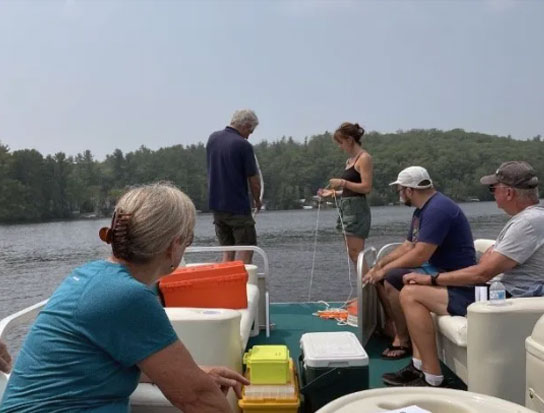
Bob Craycraft (UNH Lay Lakes Monitoring Program) and B McNamara (UNH student intern) demonstrate the best technique for sampling the upper water layer at the deepest part of Balch Lake (46 feet). From L to R: Ginny Tagliaferro, Bob Craycraft, B McNamara, Ben Polito, George Fox
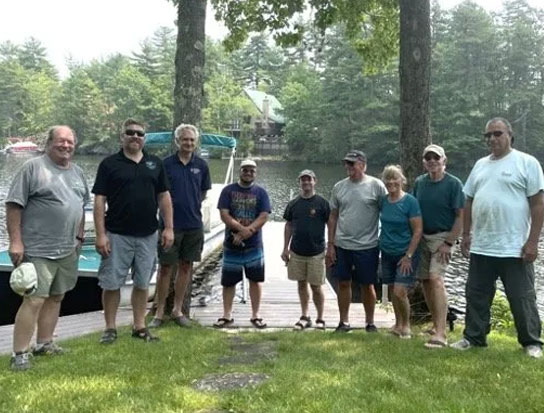
The BLIMP Water Samplers were hosted by Ginny and Tony Tagliaferro on Tuesday, July 20, 2021 for the dry-land portion of the training session. Following about 2 hours of instruction, demonstration and Q+A, the team headed out on Chris Fanger’s pontoon boat for two hours of the all-important, on-water, hands-on portion of the training. From L to R: John Castellot, Matt Koroski, Bob Craycraft (UNH), Ben Polito, Chris Fanger, George Fox, Ginny Tagliaferro, Tony Tagliaferro, Andy Rosenberg. Not pictured: Marian Zeles and B McNamara (UNH student intern . . . somebody had to take the picture)